
Earthquakes have always been part of the Australian environment and there have been over 300 recorded in New South Wales since colonial settlement in 1788. Seventeen of these have occurred in the Lower Hunter, although the event of 15 May 1906 has been attributed to mining activity in Newcastle. Here I provide an account of these earthquakes. I also introduce clergymen-scientists who, in the nineteenth century, tracked and documented seismic activity.
Lower Hunter earthquake epicentres
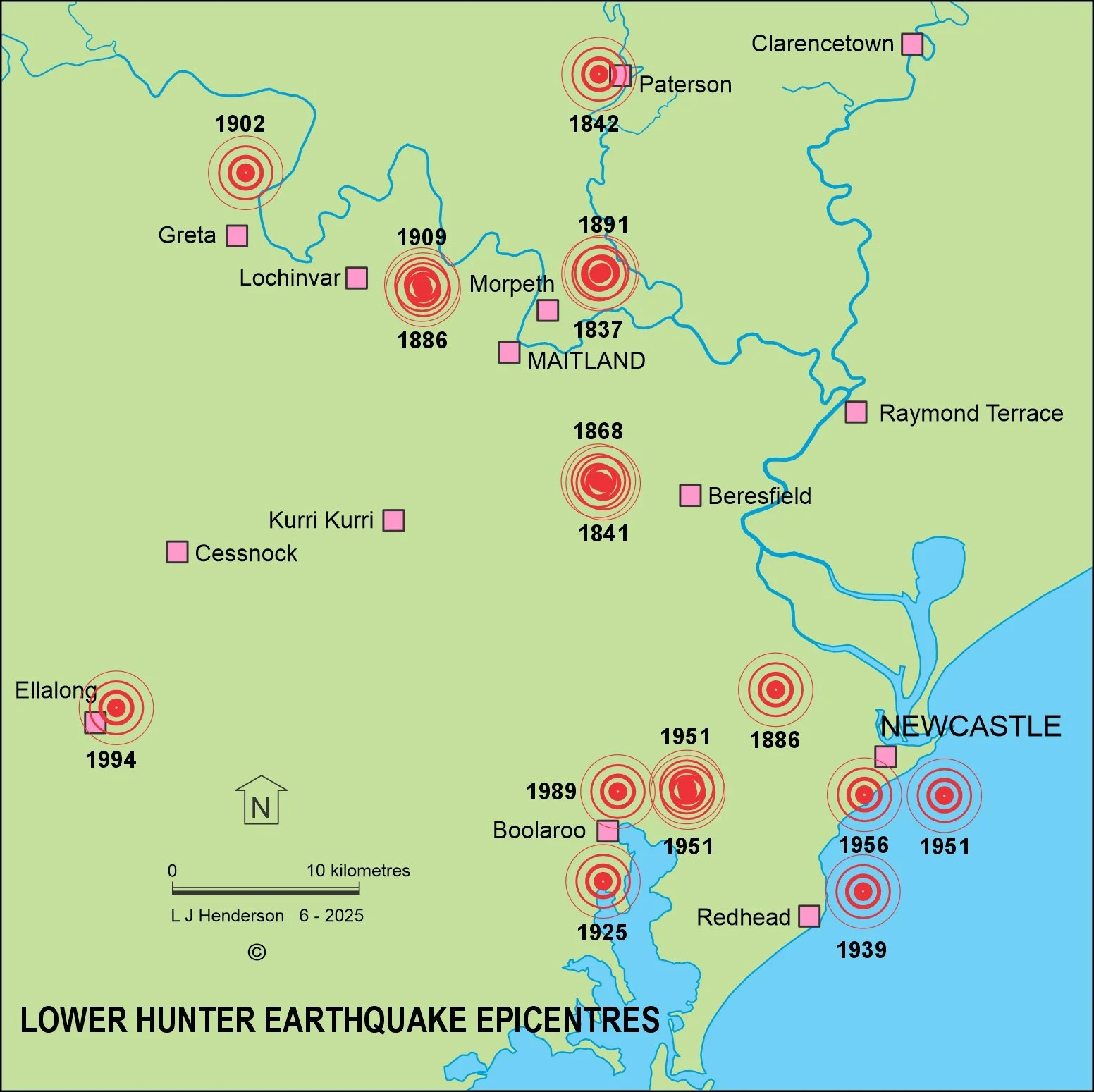
Earthquake epicentres plotted from data supplied by the Australian Seismological Centre, Canberra.
(Map: Lawrence Henderson)
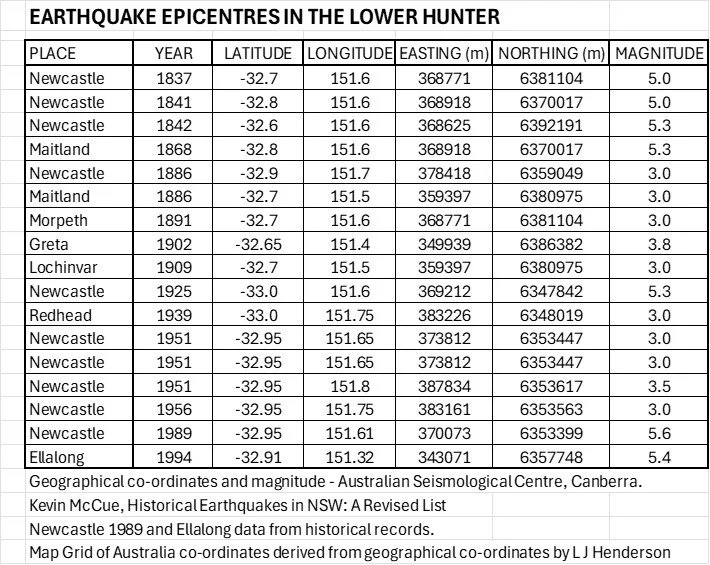
Note: Magnitudes assigned to nineteenth-century earthquakes are retrospective estimates based principally on contemporary descriptions of their effects. They should not be regarded as having the same precision as measurements obtained from modern seismic instruments.
Clergymen-scientists
Scientific pursuits, such as geology, were very much an amateur activity in the early nineteenth century. Clergymen, in particular, pursued such a ‘hobby’ often combining their religious duties with serious interests in geology, natural history and other branches of science. Charles Darwin is perhaps the most notable example. He was expected to become a country parson in England, but his attachment to Captain Fitzroy and the HMS Beagle’s voyage around the world changed that. Although Darwin had wide-ranging interests in science, he always considered himself a geologist.
In New South Wales clergymen William Branwhite Clarke of Sydney and Charles Pleydell Neale Wilton of Newcastle pursued their interests in geology and science. They reported extensively on the earthquakes they encountered. Reverend W B Clarke was eventually employed by the colonial government as a geologist. Both these men reported on earthquakes in the Lower Hunter.
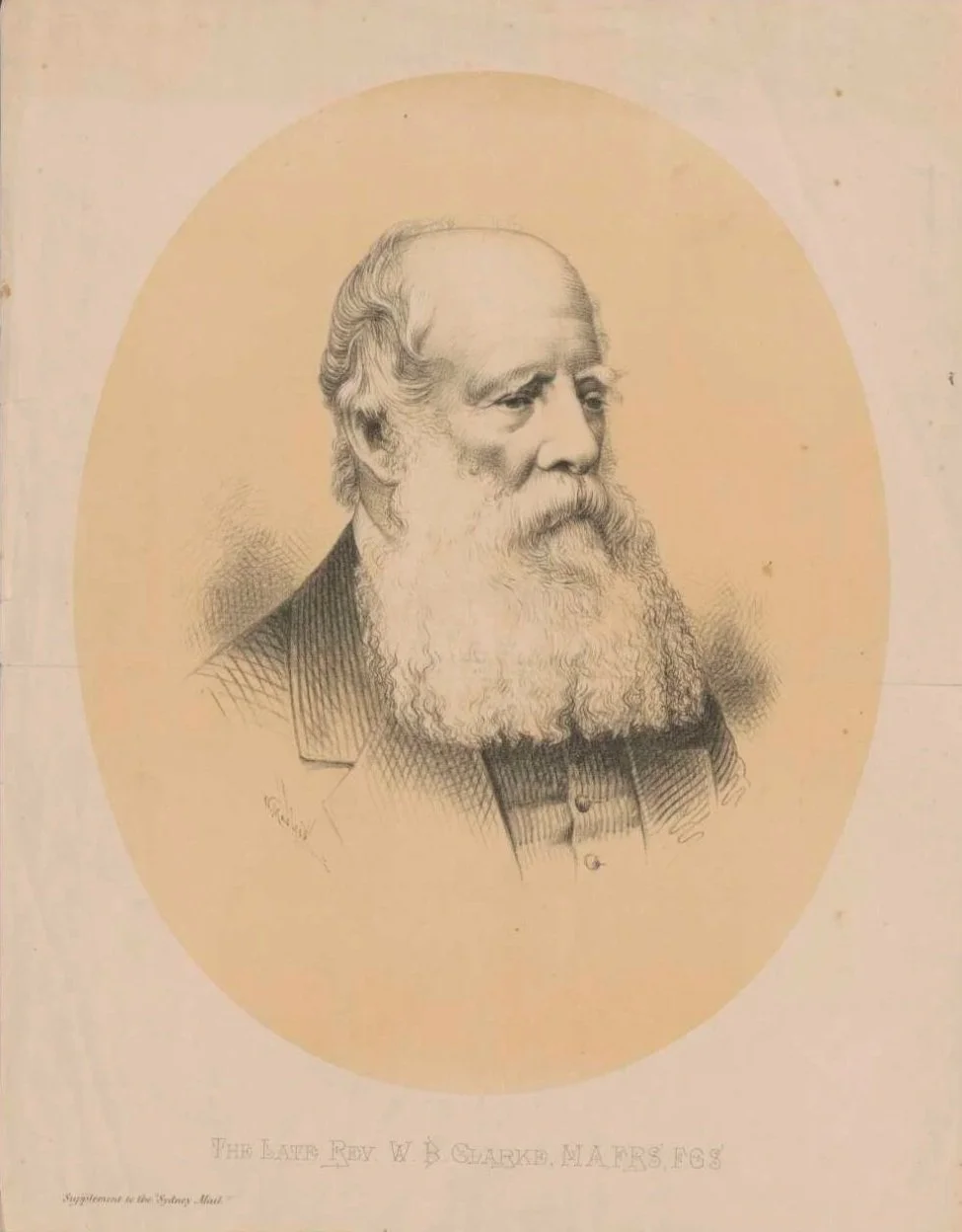
William Macleod, The late Rev. W. B. Clarke, MA, FRS, FGS, 1878.
(National Library of Australia, reproduced in Australian Dictionary of Biography)
A chronology of Lower Hunter earthquakes, 1837-1994
1837 August
The Reverend Wilton, writing to the Sydney Herald on 10 August 1837 from The Parsonage, Newcastle, described an earthquake that occurred at 10:20 pm on Wednesday 2 August. He gave a lengthy account of the quake's effects on the townspeople and buildings, and said the men working in the coal mines 23 fathoms (42 metres) below the surface felt nothing. No damage to buildings was recorded and no one was injured. A correspondent (pseudonym F.H.E.P.) wrote to the Sydney Times that the earthquake had been felt at his residence in Elizabeth Street, Sydney, and that he had received a letter from a friend at Patersons Plains describing the earthquake shock. With an estimated magnitude of 5.0, it would certainly have been felt in Maitland.
1841 January
The shock of an earthquake was felt about 7:15 am in Maitland on 28 January 1841 and reported in the Sydney Herald five days later. Tremors were also recorded from Singleton and Mr E MacKinlay from the Hermitage, Williams River, wrote an account of the event to the newspaper, including a report of the shock felt in Paterson. The Reverend Clarke, writing from his residence in Parramatta, felt the tremors and wrote a description and explanation to the Sydney Herald on 9 February. Reverend Wilton, writing again from Newcastle, felt the tremors and stated that the shock was also felt very strongly on the Williams and Paterson Rivers, at Morpeth, East Maitland, West Maitland and Patricks Plains. It had a similar magnitude (5.0) to the 1837 quake.
1842 November
The Sydney Morning Herald, on 1 November 1842, published a report of two earthquakes occurring early in the morning of 28 October. They were felt particularly strongly at Paterson, occurring at 5:25 am and consisting of a minor tremor, followed a few minutes later by a more violent shock that lasted about 40 seconds. The shocks were widely felt in the lower Hunter, Port Stephens and as far afield as Port Macquarie to the north and Windsor to the south. The earthquake was also widely reported in other Sydney newspapers. A magnitude of 5.3 has been assigned. The Sydney Morning Herald, with an eye to history, wrote an editorial, which in part stated:
We shall feel obliged by well-authenticated notices from other parts of the colony where it may have been felt, with reports of attendant phenomena, as we are anxious that full particulars of all such occurrences should be recorded in the Herald for future reference.
1868 June - Maitland’s greatest earthquake to this date
A few minutes before midnight on Thursday, 18 June 1868, the citizens of Maitland were startled or awakened by a bump and severe shaking. The following Saturday, the Mercury wrote that ‘great alarm and consternation was excited throughout the whole of West Maitland and its vicinity’. The shaking was felt over a wide area and was perceived to be the greatest at Campbells Hill. By the next day, the consensus was that an earthquake had occurred.
This was confirmed by the government geologist, the Reverend W B Clarke, who felt the tremors at his residence in St Leonards, Sydney. Newspapers in Newcastle and Sydney reported the earthquake, and the Maitland Mercury carried a full account. Newcastle felt the shock, as did Sydney. Towns as far away as Tamworth and Armidale reported feeling the tremor.
No deaths were reported, but there was some damage to buildings and infrastructure. A Mr Gulley of West Maitland escaped injury when he vacated his bed at the first shock. Moments later, a large quantity of plaster fell from the ceiling onto his pillow, where he had been peacefully sleeping. There were other reports of falling plaster, cracks in walls, dislodged bricks and a brick chimney collapse. Clocks, glassware and crockery were thrown from shelves and mantelpieces, and the walls of two houses in Bulwer Street were severely damaged. A wall of John Pender’s house in Church Street gave way, and the walls of the railway station in Elgin Street were cracked. The portico at the Bank of Australasia in East Maitland was cracked and parted from the main building, and a large quantity of plaster fell from the ceiling of the Court House in Morpeth.
The quake had quite an effect on the local animals. Dogs barked and howled incessantly, cattle showed great alarm, and poultry were thrown from their perches, with the roosters crowing lustily. The town’s pigeons were startled from their sleep and sought safety in flight.
People described the convulsion as a distinct rocking, like the motion of a ship at sea, and it produced, in some, a feeling of nausea and sea-sickness. Others in the street at the time described the earth coming up to meet them as they put their feet down. In Newcastle, residents rushed into the streets. It was said the tremors were stronger in the eastern part of the city than in the west. The earthquake was also reported from many parts of Sydney and was assigned a magnitude of 5.3.
Reverend W B Clarke presented a lengthy paper, ‘On the causes and phenomena of earthquakes, especially in relation to shocks felt in New South Wales, and other provinces of Australasia’, before the Royal Society of New South Wales on 1 September 1868. The transcript of the presentation appeared in the Sydney Morning Herald, 3 September 1868.
1886 April and September
An earthquake with its epicentre near Lithgow occurred on the morning of 26 April 1886. Tremors were felt from Newcastle to Jerrys Plains and Muswellbrook. A short report appeared in the Mercury the next day and the Newcastle Morning Herald the following day.
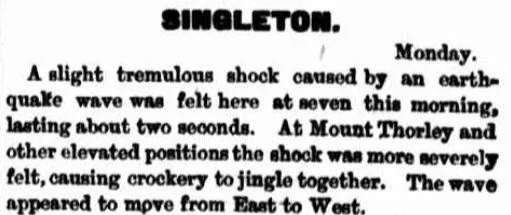
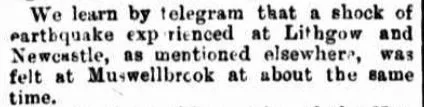
click on above images for larger views
Later that year, there were two events in the Lower Hunter. A shock was felt in Newcastle at 4:30 am on 6 September and in Maitland some time after 7 pm on 12 September. Both were recorded by the Maitland Mercury. They have been assigned a 3.0 magnitude.
1891 June
Several seismic shakes were felt throughout the day in Morpeth on 14 June 1891. C F Wakely, the Morpeth Postmaster, noticed a slight tremor at 8:40 am, which continued for about 50 minutes. A similar long disturbance was observed about 5:30 pm. The vibrations rattled the windows and door bolts. The disturbances were regarded as an earthquake swarm. It was assigned a magnitude of 3.0.
1902 February
At about 4 am on 27 February 1902, an earthquake tremor, estimated at 3.8, was recorded in Greta. The Sydney and Maitland newspapers reported that the tremors were felt in Maitland and Allendale. The shaking caused damage to the Greta Post Office buildings.
1909 May
People fled their houses on Sunday 8 May 1909 at 1 am, when 3.8 magnitude tremors were felt in Lochinvar. The Mercury reported tremors felt in Dungog, Stanhope and Maitland. The earthquake received little attention in the press; it was overshadowed by the sighting and explosion of a meteor over much of the district at about the same time.
1925 December
A 5.3 magnitude earthquake struck Newcastle a few minutes before 9 pm on 18 December 1925 and was felt from Taree to Wollongong and throughout the Lower Hunter. The quake was followed almost immediately by a severe aftershock. Patrons watching a movie at the Theatre Royal, in Newcastle, rushed for the doors in panic. The Mercury didn’t record feeling the tremors in Maitland, but the Scone Advocate wrote that the shock was distinctly felt in Denman. The Dungog Chronicle reported:
… many houses shook, crockery and windows rattled and walls creaked.
Professor L A Cotton of the Department of Geology, Sydney University, felt the shock at his residence in Hornsby at ‘47 minutes and 43 seconds after 8pm’. He said the Department would investigate the cause of the disturbance.
A seismograph had been installed at Riverview College, Sydney, in 1909 and recorded the earthquake, regarding it as severe.
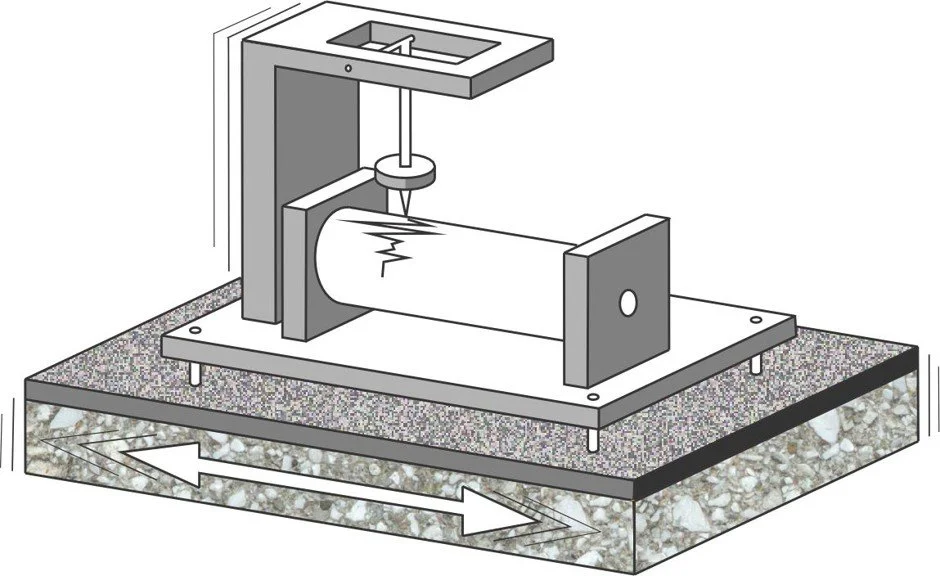
A simplified drawing of a seismograph recording the lateral movement of an earthquake.
(Lawrence Henderson)
1939 November
On 20 November 1939, tremors were felt at Redhead shortly after 3:30 pm. The 3.0 magnitude earthquake is assumed to have occurred offshore and was felt mainly along the coast from Newcastle to Swansea. This quake engendered little response and was not reported in local or metropolitan newspapers.
1951 July, November, December
In 1951, a swarm of three seismic events occurred in the Newcastle district, with two epicentres near Boolaroo. The first occurred on 9 July at about 3 pm and shook buildings in Newcastle and Lake Macquarie. The second happened at about 3 pm on 14 November. Both were estimated at a magnitude of 3.0. The third (offshore) event lasted about half an hour, starting at 9:40 am on 5 December. It was a little stronger at 3.5 and shook a similar area. The quakes did not draw much attention. Descriptions only appeared in the Newcastle newspapers.
1956 August
In 1956, at about 11 am on 16 August, another magnitude 3.0 earthquake shook Newcastle, immediately followed by a second tremor. No damage was reported, and little attention was paid. The Canberra Times published a short article about earth tremors in Newcastle and Orange.
1989 December
The most severe earthquake to strike the Lower Hunter was the Newcastle earthquake of 28 December 1989. The 5.6 magnitude quake, which struck at 10:27 am, cost lives and caused widespread damage. The epicentre was a little west of the Lake Macquarie suburb of Boolaroo, with the focus at a depth of 11.5 kilometres.
The earthquake devastated parts of Newcastle, particularly buildings in Hamilton, Broadmeadow and Newcastle West. There were 13 fatalities in Newcastle and about 160 people suffered injuries requiring hospitalisation. Throughout Newcastle and Lake Macquarie about 40,000 homes were damaged and about 10,000 commercial and other buildings (including 147 schools) suffered a similar fate. The worst-hit building was the Newcastle Workers Club, where the internal structure collapsed, resulting in nine deaths. Three people were crushed to death by falling masonry in Beaumont Street, Hamilton and a person later died from shock related to the earthquake.
Maitland, almost directly north of the epicentre, in comparison, suffered very little damage. There were no fatalities, and some masonry buildings suffered minor cracking. The car park beneath the Kmart building sustained some cracking to the brickwork but was later deemed structurally sound. In the city administration building, some ceiling panels fell and a piece of decorative stonework fell from the Town Hall clock tower. The City Engineer inspected some local public buildings and bridges for structural damage. All were deemed sound.
During the quake in Maitland, people ran from shops in panic and electric power failed, disrupting traffic lights and communications. The worst damage was to Mansfield House, then home to the National Australia Bank (formerly the Commercial Banking Company of Sydney) on High Street. The building’s ornamentation included two decorative sandstone urns adorning the parapet above the main entrance.
During the earthquake, the urns broke off and tumbled to the ground. It was fortunate that nobody was standing beneath them as they fell. The urns smashed the concrete pavement and lay half-buried in the footpath from the momentum of the fall.
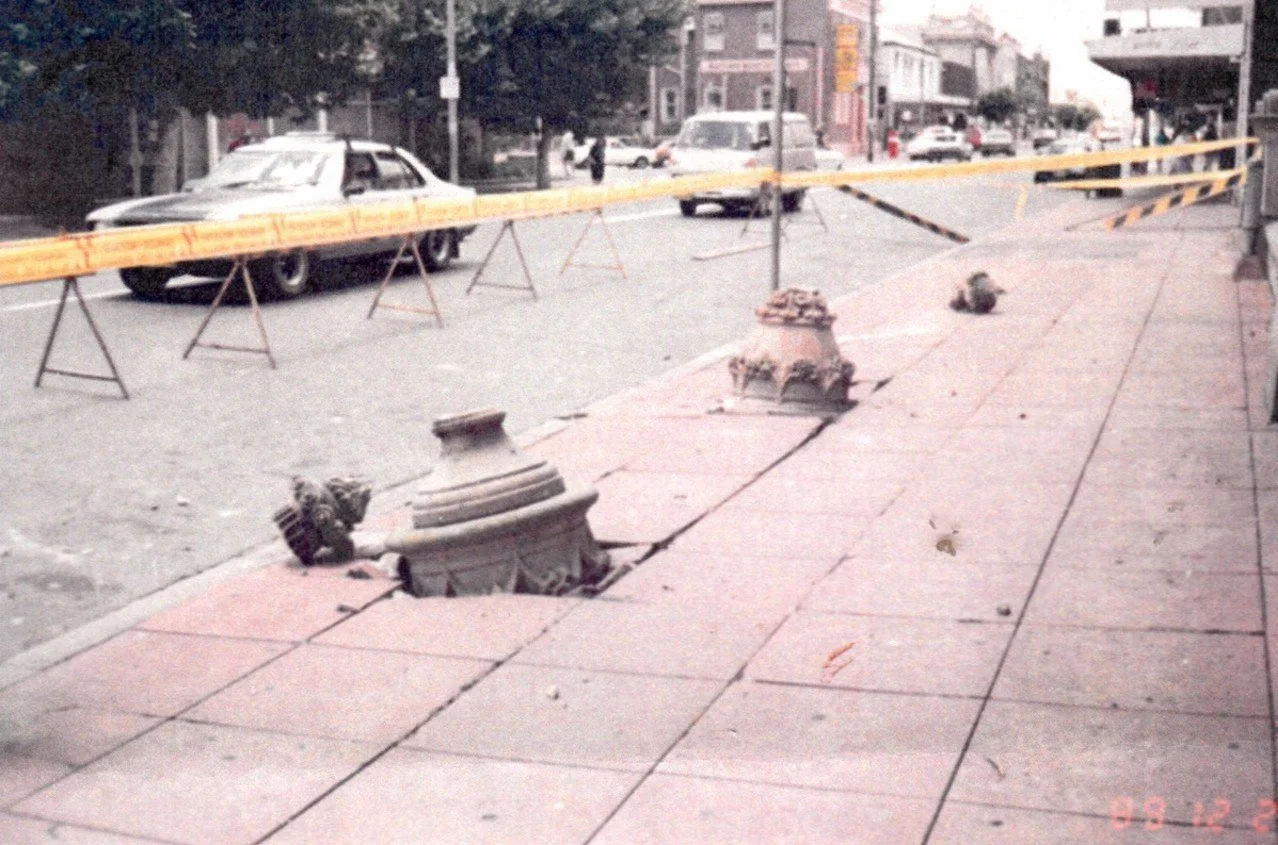
The urns from Mansfield House half-buried in the footpath after the 1989 earthquake.
(Photo: Suzanne Martin)
Dr David Denham, of the Australian Seismological Centre in Canberra, said a team from the Centre had set up seismographic recorders in Newcastle immediately after the quake. A single aftershock, magnitude 2.1, was detected at the Boolaroo location the next day at a focal depth of 13.6 kilometres. No damage was recorded.
1994 August
On 6 August 1994, a magnitude 5.4 earthquake occurred at a depth of about 1.4 kilometres in Ellalong. The quake occurred at 9:04 pm and severely shook the villages of Ellalong and Paxton. There was severe damage to the Ellalong Hotel and over 1000 homes in the Cessnock district suffered cracked walls, collapsed chimneys and shifted foundations. No fatalities were recorded; however, five people suffered minor injuries. In the Ellalong Colliery, 17 miners were trapped underground when the power failed. They were all subsequently rescued.
Next?
The historical record demonstrates that earthquakes, although relatively infrequent, are a recurring feature of life in the Lower Hunter. Most have caused little damage, but the earthquakes of 1868, 1989 and 1994 remind us that the consequences can be considerable. We live on the surface of a dynamic Earth, and further earthquakes are inevitable. When and where the next significant earthquake will occur, however, remains unknown.
Acknowledgement
Thanks to the National Library’ of Australia’s Trove Service for on-line access to past newspapers. It has been an invaluable reference.
References
Canberra Times : ‘Severe earth tremors today shook Newcastle and Orange districts’, 17 August 1956.
Doyle, M., ‘Newcastle earthquake victims remembered’, Maitland Mercury, 28 December, 2019.
Dungog Chronicle : ‘Earth tremor disturbs Dungog’, 22 December 1925.
Grainger, Elena, The Remarkable Reverend Clarke, Oxford University Press, Melbourne, 1982.
‘Ground shaken in the Hunter’, Newy, 87.8 FM Newcastle, newy.com.au
Henderson, Lawrence, ‘Our past: how Maitland survived the December 1989 earthquake’, Maitland Mercury, 19 November 2023.
Henderson, Lawrence, ‘Our past: Maitland earthquake of 1868 shook community’, Maitland Mercury, 1 June 2025.
Henderson, Lawrence, ‘Our past: quakes in the Lower Hunter: when will the next earthquake be?‘, Maitland Mercury, 13 July 2025.
Kirkwood, I., ‘Newcastle Earthquake 30 years later, Part I: The seismic shock that shook Newcastle to its core’, Maitland Mercury, 23 December, 2019.
Maitland Daily Mercury : ‘The earthquake shock,’ 3 March 1902; ‘District News’, 4 March 1902; ‘A brilliant meteor’, 10 May 1909; ‘The quake. Purely of local origin’, 21 December 1925.
Maitland Mercury and Hunter River General Advertiser : ‘Earthquake’, 20 June 1868; ‘The earthquake’, 23 June 1868; ‘Singleton’, 27 April 1886; ‘The recent earthquake’, 1 May 1886; ‘Earthquake’, 14 September 1886; ‘Singular phenomenon’, 18 June 1891.
McCue, Kevin, ‘Australia: historical earthquake studies’, Annals of Geophysics, 47, 2004.
McCue, Kevin, Historical Earthquakes in NSW: A Revised List, Australian Seismological Centre, Canberra, 2012.
McCue, K., Wesson, V. and Gibson, G., ‘The Newcastle, New South Wales, earthquake of 28 December 1989’, BMR Journal of Australian Geology & Geophysics, 11 .559-567, Commonwealth of Australia, 1990.
Newcastle Chronicle : ‘Heavy shock of an earthquake in the Hunter River District’, 20 June 1868; ‘The late shock of earthquake’, 24 June 1868.
Newcastle Morning Herald and Miners Advocate : ‘Local and General News’, 28 April 1886; ‘Greta: an earthquake tremor’, 3 March 1902; ‘Earthquake shock. District shaken. Alarm in theatres’, 19 December 1925; ‘Earth tremors shake homes in Newcastle District’, 10 July 1951; ‘Rumbling was not thunder’, 15 November 1951.
Newcastle Sun : ‘More rumblings underground’, 5 December, 1951.
Scone Advocate : ‘Local and General News’, 23 December, 1925.
Sydney Herald : ‘Earthquake at Newcastle’, 10 August 1837; ‘Patrick Plains earthquake’, 2 February 1841; ‘Earthquake at Maitland’, 2 February 1841; ‘Earthquake’, 5 February 1841; ‘Earthquake’, 9 February 1841; ‘The earthquake’, 19 February 1841; ‘Earthquakes’, 3 September 1868.
Sydney Morning Herald : ‘Earthquake’, 31 October 1842; ‘The earthquake’, 1 November 1842; ‘Newcastle – earthquake’, 1 November 1842; ‘Port Stephens – earthquake’, 1 November 1842; ‘Paterson – earthquake’, 2 November 1842; ‘Maitland’, 11 November 1842; ‘The shock of earthquake’, 22 June 1868; ‘Brilliant meteor’, 10 May 1909; ‘Seismology at Riverview. Professorial visit’, 22 May 1909; ‘Probable cause. Fracture of the earth’s surface. Professor Cotton’s opinion’, 19 December 1925.
Sydney Times : ‘To the Editor of the Sydney Times’, 19 August 1837.
